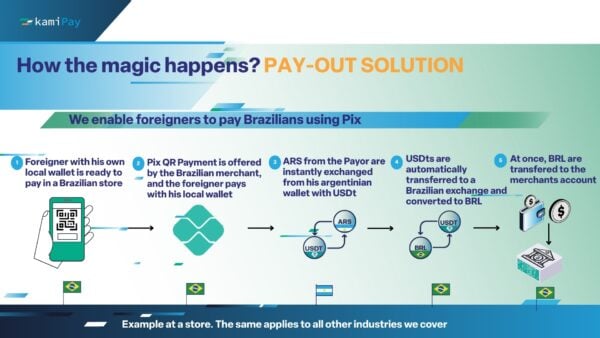
Argentinian Fintech Kamipay’s deliberate strategy for providing cross-border, real-time payments in LatAm’s diverse market is successful. The infrastructure enables Argentines to pay with Pix in Brazil directly from their local apps, and that’s just the beginning.
CFO and late co-founder Eduardo Dundas said Kamipay has found success in serving tourism and related industries, ones Argentines use most when travelling to Brazil. Those tourists scan a QR code to connect their app, transaction details are shown on their screen, and it is completed in 10 seconds. An API facilitates simple integration with hotel booking engines and POS systems.
Dundas said co-founders Matias Rodrigo Gorganchian and Nicolás Enrique Bourbon were early Bitcoin adopters who quickly saw how blockchain could solve a regional problem. Real-time payments were gaining popularity, especially after PIX was made mandatory in Brazil.
Gorganchian and Bourbon are on a path to see how blockchain and stablecoins could advance real-time payments
 That worked great for local consumers, less so for visitors paying in other currencies or foreign debit and credit cards. That set Gorganchian and Bourbon on a path to see how blockchain and stablecoins could advance real-time payments.
“We saw that, obviously, Brazilians were attracted to those stores that had that sign saying that PIX was accepted,” Dundas said. “And the other insight we’ve got there was that they spent more when they used PIX than when they had to use other means of payment.”
Kamipay has expanded so Brazilians can pay with PIX in Argentina, too. It’s a model that could grow regionally.
“Now PIX was now not only for Brazilians paying in Brazil, but also for Brazilians paying in those stores where our community-based solution was offered,” Dundas added.
The local currency is connected and converted to stablecoins before being sent to the hotel, restaurant or retailer’s account, where it is converted into the local currency. All of this happens in 10 seconds, down from as long as three days for SWIFT international transfers
Stablecoins are key for Kamipay
Stablecoins are the key. Once the QR code is scanned, the payment is confirmed. The local currency is connected and converted to stablecoins before being sent to the hotel, restaurant or retailer’s account, where it is converted into the local currency. All of this happens in 10 seconds, down from as long as three days for SWIFT international transfers.
“(The consumer) knows exactly how much they are paying in their local currency, and the transaction is settled in seconds,” Dundas said.
Businesses are embracing Kamipay’s API as they seek better customer payment solutions. Those customers enjoy a respite from high credit card fees and international payment delays.
Dundas said Kamipay was initially offered to local wallets in Argentina. One startup wallet company integrated Kamipay and quickly shot up to number one. Consumers use it for everyday purchases and money transfers.
Overall, Kamipay facilitates 300,000 transactions worth $8 million every day.
Credit Kamipay for cracking the nut of introducing a new technology without having to educate the consumer. They use familiar tools like wallets and QR codes, while blockchain does its magic in the background.
“The most impressive thing they figured out to solve here is to use blockchain technology, but without the need for participants to know anything about it,” Dundas said. “You can travel to Brazil, use your local app, and buy something at the beach. You pay with your local currency, the Brazilian receives reais instantly, and you have no idea that you are also using blockchain.
“We have introduced a fully crypto experience.”
LatAm is a multi-faceted payments region
Some make the mistake of assuming LatAm is a homogeneous region, but it is anything but. Dundas said different countries are approaching real-time payments in different ways.
Colombia is developing a PIX-like solution. Mexico and Chile are further behind. Argentina has strong adoption.
“We have different smaller wallets,” Dundas explained. “What the Central Bank did here in Argentina is create a protocol that makes them connectable, so that you can send money to a user who has any other wallet. This is the Argentinian model.”