
For decades, robots have been defined by precision, strength, and speed. What they lacked was something far more subtle: touch.
Without it, machines struggle with tasks humans find instinctive, like gripping a fragile object or adjusting pressure mid movement. Artificial skin is beginning to change that, giving robots a way to feel contact rather than simply detect it.
At CES 2026, this shift became visible in a practical way. Artificial skin appeared as a working layer integrated into robotic hands and surfaces, designed to move beyond experiments and into real use. The focus was not spectacle. It was control, sensitivity, and reliability.
What artificial skin actually does
Artificial skin is built from soft, flexible materials embedded with dense arrays of tiny sensors. These sensors register pressure, movement, and subtle changes across the surface. Every point of contact produces data, allowing a robot to understand how an object feels rather than just where it is.
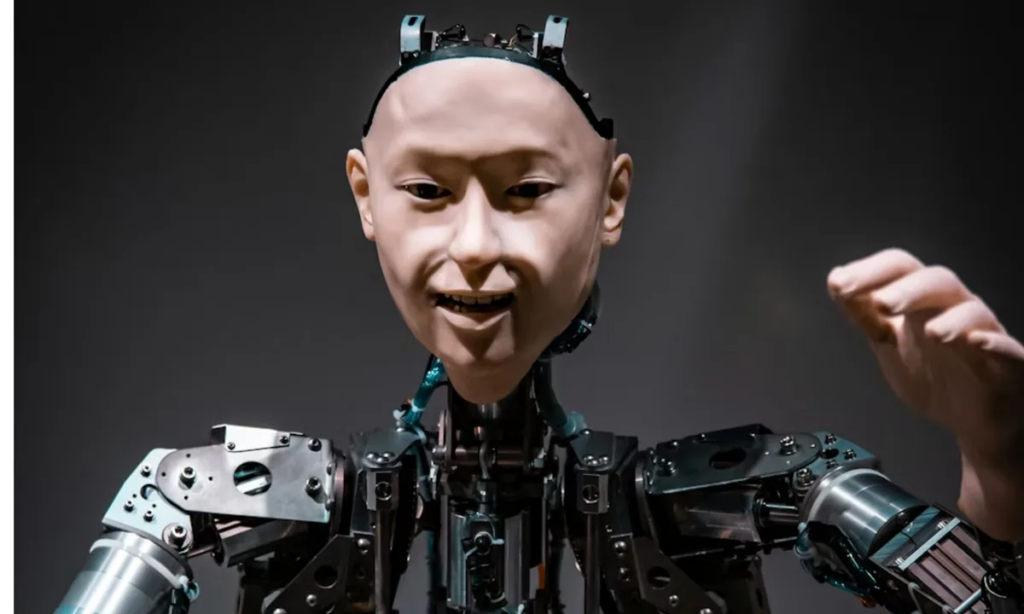
Image Credits: Digital Trends
Modern designs are thin and responsive. Some systems pack hundreds of sensing points into a small area and read them thousands of times per second. Processing happens close to the surface, which allows reactions to happen almost instantly. A robot can ease its grip as soon as an object begins to slip or reduce force when handling something delicate.
This turns touch into a continuous signal instead of a simple on off response.
One challenge in artificial skin development is covering complex shapes. Flat tactile grids work fine on planar surfaces but not on curved robot arms or hands. Today’s advanced designs solve that with modular patterns that tile smoothly and conform to non-flat structures. These systems distribute sensing modules and embedded computing directly into the sensing layer, avoiding bulky cables and slow data paths.
This makes tactile coverage scalable. Instead of just fingertips, robots can have sensory awareness across palms, backs of hands, and entire forearms.
Why touch changes how robots behave
Vision helps robots understand shape and position, but touch explains interaction. When a robot can feel pressure and movement, it can adapt in real time. This matters in environments where objects vary in size, texture, and fragility.
With artificial skin, robots can handle items that once required careful human handling. They can respond safely to unexpected contact. They can operate in shared spaces with people while maintaining awareness of physical boundaries.
This sensitivity makes robots more flexible and less dependent on precise programming for every task.
From fingertips to full surface awareness
Early tactile sensors were limited to fingertips or small contact points. New artificial skin systems are designed to wrap around curved surfaces, covering fingers, palms, arms, and larger body areas.
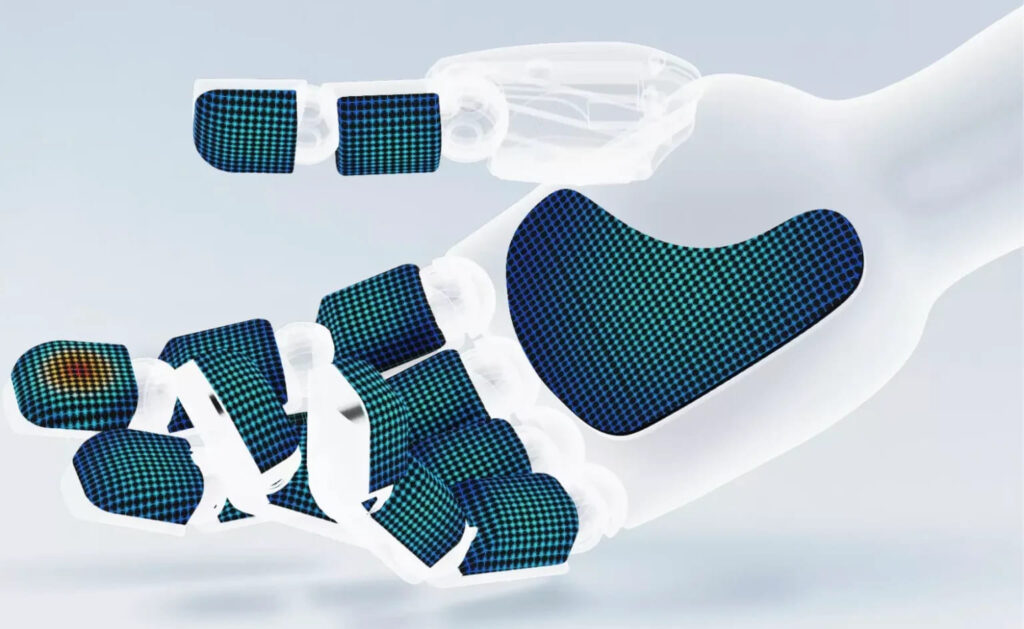
Image Credits: Absolute Geeks UAE
Full surface awareness gives robots a more complete understanding of contact. A brush against an arm or a gentle push on a shoulder becomes meaningful input rather than noise. This level of awareness supports safer movement and more natural interaction.
Some systems also support rapid protective responses when pressure exceeds safe levels, helping prevent damage to both the robot and its surroundings.
Companies pushing tactile sensing forward
Several companies are turning artificial skin from concept into working systems that robots can really use.
One standout example is XELA Robotics, which has developed a tactile sensor system called uSkin.
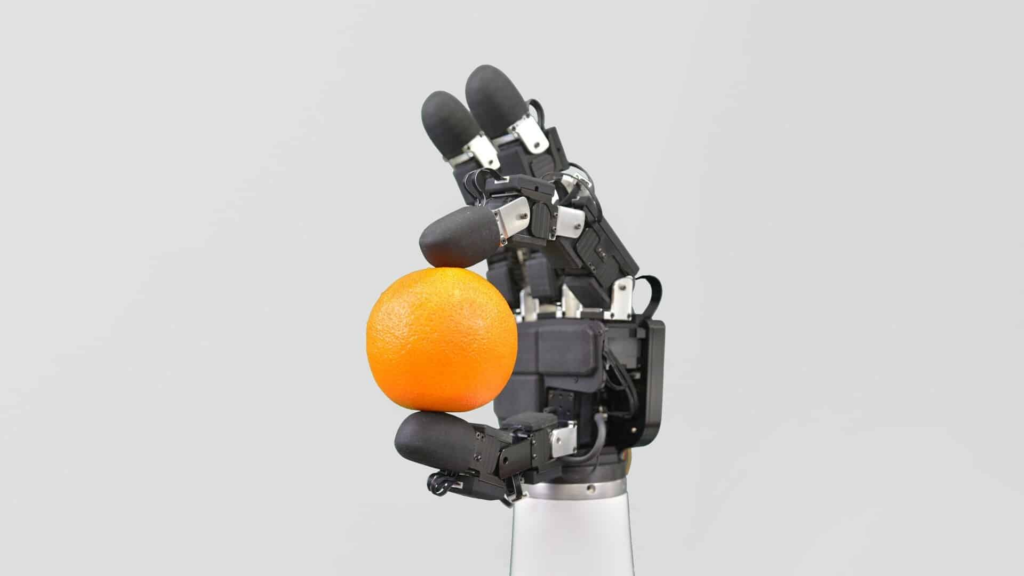
Image Credits: iGrow News
This multilayer sensor combines a flexible, protective surface with dense three-axis sensing modules. It can measure how tightly a robot holds something, track how the object moves inside a grip, and provide detailed touch feedback across palm and finger surfaces. The system has been integrated with existing robotic hands and grippers from multiple manufacturers, making it easier to upgrade real robots with human-like touch awareness.
Another company making waves is Ensuring Technology. Its tactile platform includes sensors such as Tacta, which packs hundreds of sensing elements into each square centimeter and delivers high-resolution touch data in real time.
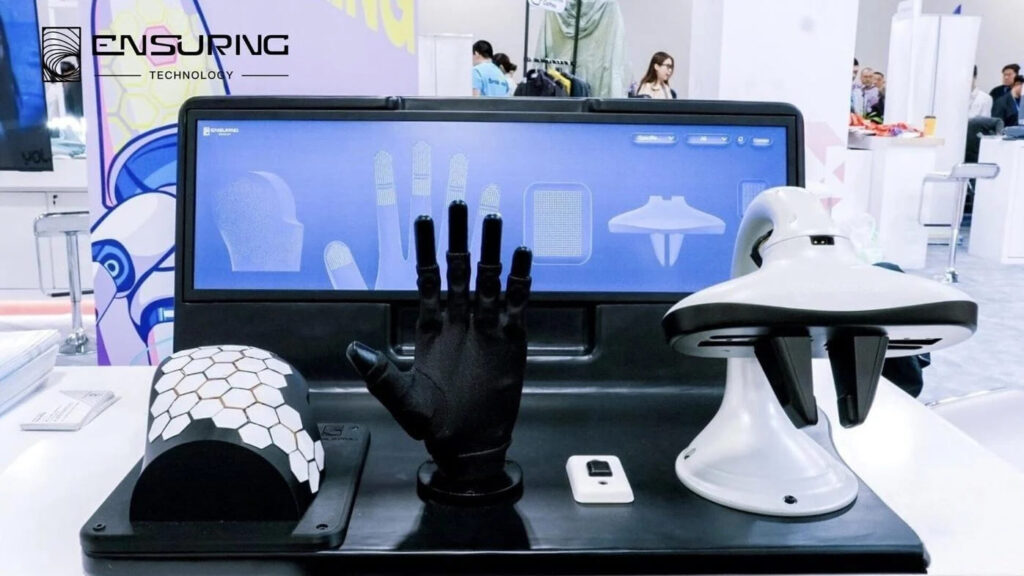
Image Credits: WV News
In demonstrations, a single robotic hand fully covered with this layer showed how tactile coverage across fingertips and palm gives robots a dense, human-like sense of contact.
Ensuring’s HexSkin system is designed to cover larger curved surfaces, making whole arms or bodies touch-sensitive without bulky wiring.
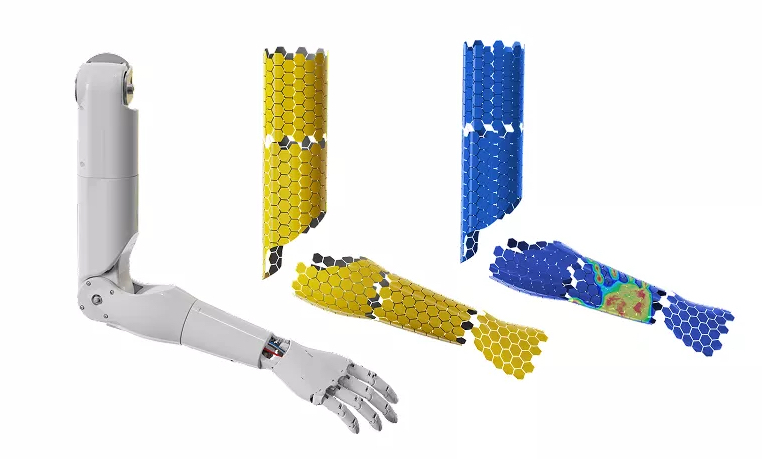
Image Credits: Digital Trends
These developments make it far easier for robots to interpret contact signals efficiently and at lower cost.
Beyond these, other parts of the field are advancing as well. Emerging firms are creating high-density tactile membranes that rival human sensitivity, while research teams develop flexible sensors capable of detecting fine forces and even temperature changes. Over time, these technologies will open new possibilities for robots that interact safely and intuitively with their environments and with people.
Beyond robotics
Artificial skin also plays an important role outside traditional robotics. In prosthetics, tactile layers restore a sense of physical feedback to users. Feeling grip strength, texture, or temperature improves control and confidence during everyday tasks.
Wearable versions of the technology offer new possibilities in rehabilitation and health monitoring. Because the materials are soft and flexible, they can blend into daily life without feeling intrusive.
Across these applications, touch becomes a source of connection rather than limitation.
Looking ahead
Artificial skin continues to evolve as materials improve and designs become more robust. The direction is clear. Robots are gaining the ability to interact with the physical world through sensation, not just calculation.
As this technology matures, robots will become more capable in spaces that demand care, adaptability, and safety. Touch adds context to motion. It allows machines to respond with nuance.
Robots learning to feel marks a quiet but meaningful shift. Artificial skin is the layer that brings machines closer to the physical world we navigate every day.